Ten artykuł jest też dostępny w języku: polski. How to write wedding vows: a simple method, examples and a vow builder →
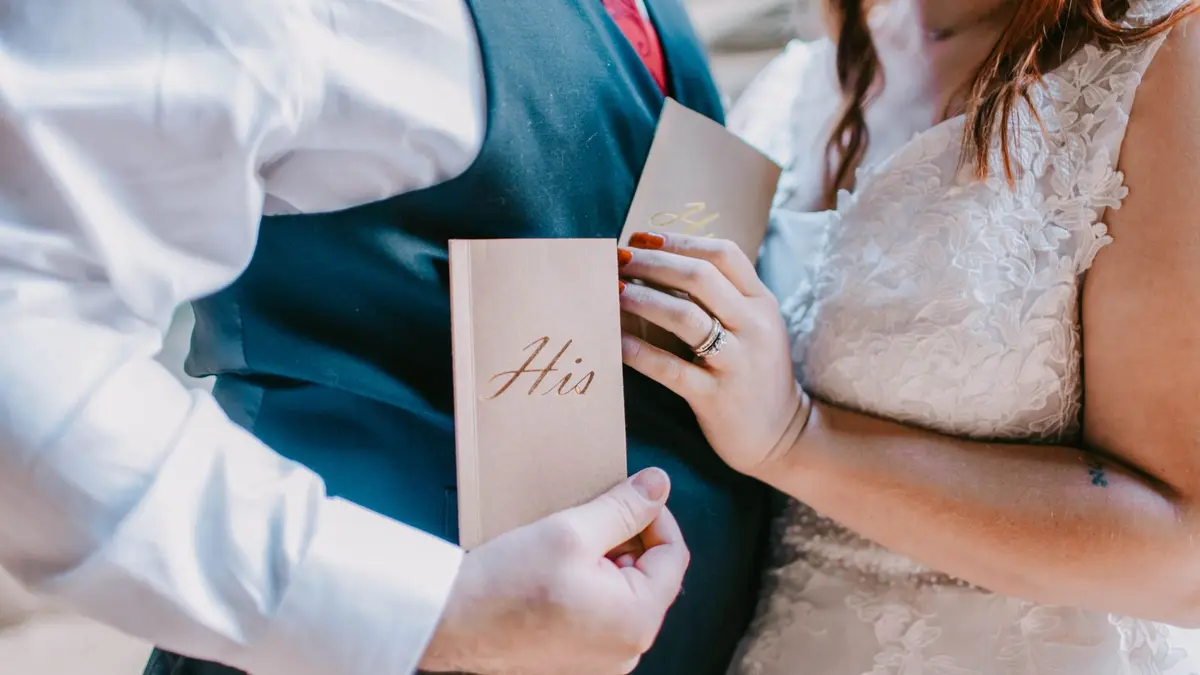
How to write wedding vows: a simple method, examples and a vow builder
Writing your own wedding vows feels enormous until you break it into small pieces. You don't need to be a poet. You need three or four true things, said clearly, in your own voice. This guide shows you how, with a vow builder that turns your answers into a first draft in a couple of minutes.
In this article
- First: agree on a few ground rules
- What's your vow style?
- The five-part vow structure
- Build your first draft
- Wedding vow examples
- Traditional vows, if you'd like to include them
- How long should wedding vows be?
- Tips for writing vows that sound like you
- Reading your vows on the day
- Vows for different kinds of weddings
- If you're stuck: prompts that help
- One last thought
- Questions couples ask
Most people who write their own vows say two things afterwards. First, that it was harder to start than they expected. Second, that it was one of the best parts of the whole wedding. Personal vows are the one moment of the day that belongs entirely to the two of you, said out loud in front of everyone you love. They don't have to be long, clever or poetic. They just have to be true.
This guide walks you through a simple five-part structure, gives you original examples in different tones, and includes two tools: a short quiz to find your vow style, and a vow builder that turns a few honest answers into a first draft you can shape into something unmistakably yours.
First: agree on a few ground rules
Before either of you writes a word, have a short conversation. It prevents the classic wedding moment when one person reads a heartfelt page and the other reads three funny lines from a napkin.
What's your vow style?
Not sure where to start? Answer four quick questions. Your result gives you a tone to aim for, which makes the blank page much less scary. Share it with your partner and compare.
Four questions, about 30 seconds.
- At a party, you're usually…
- Your favourite kind of card to receive says…
- Speaking in front of people makes you feel…
- The best thing about your relationship is…
Answer all 4 questions to see your result.
The five-part vow structure
Almost every memorable vow follows the same shape. You don't have to use all five parts, but if you're stuck, this structure gives you a path from the first line to the last.
- The opening: speak to them
Start with their name and a sentence that sets the tone. “Sam, I've written this a dozen times, and every version starts with the same word: you.”
- The story: the moment you knew
One specific moment, told in a few sentences. The day you met, the day you knew, a moment that showed you who they really are.
- What you love: who they are
Two or three specific qualities, ideally with examples. Not “you're kind”, but “you remember the name of every barista in our neighbourhood”.
- The promises: what you'll do
The heart of your vows. Mix big promises (“to choose you on the hard days”) with small, real ones (“to always save you the last bite”).
- The close: a line to end on
A short, strong sentence they'll remember. “I'm yours, today and every day after.”
Build your first draft
Fill in the prompts below with your own words. Don't polish them yet, just write what's true. The builder arranges them into a draft in the tone you choose, and tells you how long it will take to read aloud. Nothing you type is saved or sent anywhere.
Answer a few prompts in your own words. The builder arranges them into a first draft with a clear beginning, middle and end. Then make it yours.
Nothing you type leaves your browser. Read your draft out loud with a timer: most people speak around 130 words a minute when they're nervous.
Treat the result as raw material. Copy it into a document, read it out loud, and change every line that doesn't sound like you. By the third or fourth pass, it won't feel like a template anymore.
Wedding vow examples
Here are original examples in different styles to inspire you. Borrow the structure, not the words: your vows will mean much more with your own details.
Alex, the night we met, you stayed after everyone left to help me stack chairs, and talked to me for three hours about bridges.
I didn't know a thing about bridges. I just knew I wanted to keep listening.
I love the way you notice everything, and the way you make everyone feel noticed.
Today I promise to listen, even when I don't know the subject.
I promise to be your partner in every plan and every detour.
And I promise to build a life with you that's stronger than any bridge.
I'm yours.
Jordan, I promised myself I wouldn't cry, so if I do, please pretend it's allergies.
You are the most patient person I know. You've watched me lose my keys four hundred times and never once said “again?”
I promise to love you, to support your dreams, and to finally learn which drawer the scissors live in.
I promise to share the last slice of pizza (most of the time).
And I promise that, for the rest of our lives, you'll never have to laugh at a bad joke alone.
Priya, you are my calm, my home and my favourite person.
I promise to love you honestly, to choose you daily, and to grow old laughing with you.
I'm so glad it's you.
Chris, today I promise:
to tell you the truth, even when it's hard;
to be patient, even when we're tired;
to celebrate your wins as if they were mine;
to make the coffee on Monday mornings;
and to keep falling in love with you, again and again.
Taylor, you didn't just make me a partner. You made us a family.
I've watched you teach Mia to ride a bike and sit up through every fever.
Today I promise to keep loving you, and to keep loving us,
the three of us, through every school morning and every adventure still to come.
Traditional vows, if you'd like to include them
Many couples combine personal vows with a traditional promise, either said together or repeated after the officiant. The traditional English wording, which dates back centuries, is still loved for its rhythm:
I, [name], take you, [name], to be my wedded [husband / wife / partner],
to have and to hold from this day forward,
for better, for worse, for richer, for poorer,
in sickness and in health, to love and to cherish,
till death do us part.
A common approach is to read your personal vows first, then say the traditional promise as you exchange rings. It gives guests a moment they recognise, and gives you the comfort of familiar words when emotions run high.
How long should wedding vows be?
Most personal vows run between one and two minutes each, which is about 150 to 250 words read at a calm pace. That's long enough to say something real and short enough to keep the ceremony moving. The vow builder shows your word count and reading time as you go.
| Length | Words | Time out loud | Good for |
|---|---|---|---|
| Short | 60–120 | under a minute | Shy speakers, civil ceremonies, elopements |
| Classic | 150–250 | 1–2 minutes | Most weddings |
| Long | 300–400 | 2–3 minutes | Couples who love to tell stories; keep it to one long story |
The best vows aren't the most poetic. They're the most specific.
Tips for writing vows that sound like you
Read each sentence out loud. If you wouldn't say it at dinner, rewrite it.
Names, places, small habits. Details are what make guests lean in.
If you open funny, end sincere. If you open sincere, one light line helps you breathe.
No exes, no in-jokes only two people understand, nothing your grandmother would rather not hear.
Write a messy draft a month before. Edit it twice. Final version a week out.
Use “you” more than “I”. Vows are a gift to your partner, not a speech about yourself.
Reading your vows on the day
Writing your vows is half the work. Reading them well is the other half, and a little practice goes a long way.
- Practise out loud
Read them to yourself at least five times in the week before, out loud, standing up. Your mouth needs to know the words, not just your eyes.
- Print them nicely
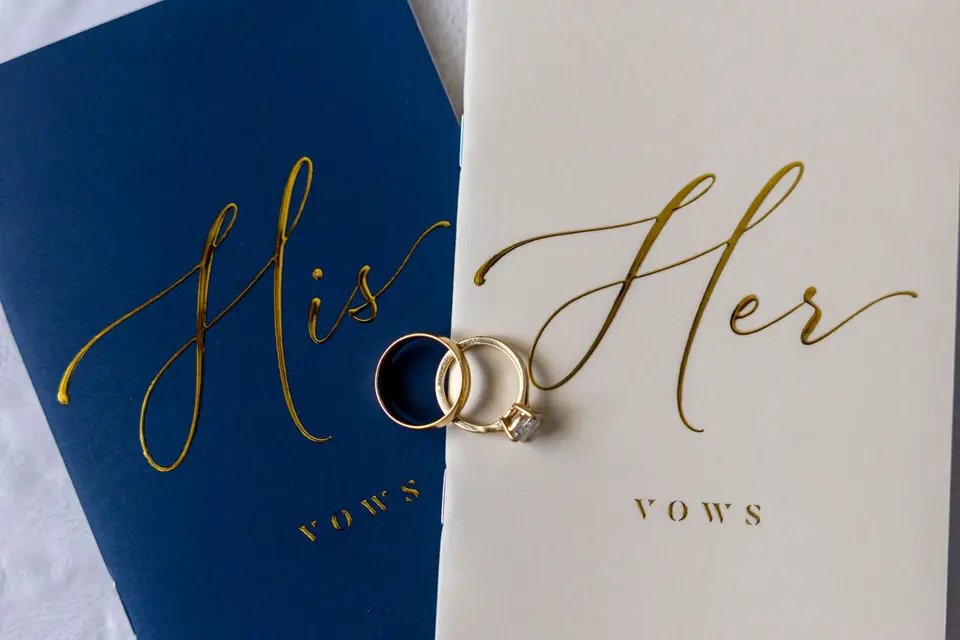
A vow book or a card looks lovely in photos and is easy to hold. A phone screen can dim, ring or reflect, and doesn't look great in photos.
- Mark your pauses
Add a slash where you want to breathe. Pauses feel long to you and perfect to everyone else.
- Slow down
Nerves make everyone speed up. Read at about half the speed that feels natural.
- Look up
Look at your partner at the end of each paragraph, not just the end of your vows.
- Give a copy to your officiant
If your vow book goes missing, your officiant has a backup.
Vows for different kinds of weddings
Elopements and tiny weddings
With only a few people present, or none at all, vows can be longer and more intimate. You're speaking to one person, not performing for a room. Some couples write letters instead and read them privately before the ceremony, then say short traditional vows in front of the officiant.
Second marriages and blended families
If either of you has children, consider including a few words for them, or a short promise to the whole family. Keep the focus forward, on the life you're building, rather than on what came before.
Vow renewals
Renewal vows have something first vows don't: evidence. You can name the years, the moves, the hard seasons and the small rituals you've built. “Ten years ago I promised to love you. Here's what I've learned that means” is a powerful way to begin.
Gender-neutral and inclusive wording
Personal vows don't need roles or titles at all. If you use the traditional promise, “partner”, “spouse” or simply your partner's name all work beautifully in place of “husband” or “wife”, and many officiants are happy to adapt the wording to fit you.
If you're stuck: prompts that help
Still staring at a blank page? Answer a few of these questions on paper, quickly, without editing. One of them will lead to your opening line.
- When did you first know this was different from any relationship before?
- What's something small they do that nobody else notices?
- What's the hardest thing you've been through together, and what did they do?
- What do you want your life to look like in ten years, together?
- What do they make easier? What do they make better?
- What would you want them to remember if they had a terrible day ten years from now?
Once your vows are ready, the rest of your ceremony wording is easier. Our guides to wedding invitation wording and the wedding day timeline help you plan how the ceremony fits into the day, and when you're ready to invite your guests, you can create a matching online invitation in minutes.
One last thought
Nobody will remember whether your vows were perfectly phrased. They'll remember your voice catching on one line, your partner's face as they listened, and the moment the room went completely quiet. Write something true, say it slowly, and look up. That's all great vows are.
Questions couples ask
How long should wedding vows be?
Most personal vows are one to two minutes each when read aloud, which is roughly 150 to 250 words. Agree on a length with your partner so your vows feel balanced.
How do I start writing my wedding vows?
Start by answering a few prompts without editing: when you knew, what you love about them, and what you want to promise. Then arrange your answers into an opening, a story, what you love, your promises and a closing line.
Should we share our vows with each other before the wedding?
Some couples do, so the tone and length match; others keep them a surprise and share them only with the officiant. A good middle ground is to agree on length and tone and keep the words secret.
Can we use traditional vows and personal vows?
Yes. Many couples read personal vows first and then repeat traditional vows, or the officiant's chosen wording, as they exchange rings.
Is it okay to read vows from a phone?
It works, but a printed card or vow book is easier to hold, won't dim or ring, and looks better in photos. Give your officiant a backup copy.
What should not be included in wedding vows?
Avoid mentioning exes, private jokes that exclude guests, very personal details your families may find uncomfortable, and promises that could sting later.
Make your invitation in minutes
Beautiful designs, an RSVP for each guest and automatic reminders. Free for up to 25 guests.
Start freeKeep reading
-
 23 listopada 2026 · 14 min read
Wedding invitation etiquette: the complete guide to the dos and don'ts
Wedding invitation etiquette for today's couples: who to invite, who hosts, timing, plus-ones, children, registry, dress code, RSVPs and sending invitations online.
-
 23 listopada 2026 · 14 min read
How to address wedding invitations: examples for every guest
How to address wedding invitations and envelopes: married couples, different last names, doctors, families, plus-ones, widowed guests and online invitations.
-
 23 listopada 2026 · 13 min read
Wedding dress codes explained, from black tie to casual
Every wedding dress code explained: white tie, black tie, black tie optional, cocktail, semi-formal, beach and casual, plus how to put a dress code on your invitation.